
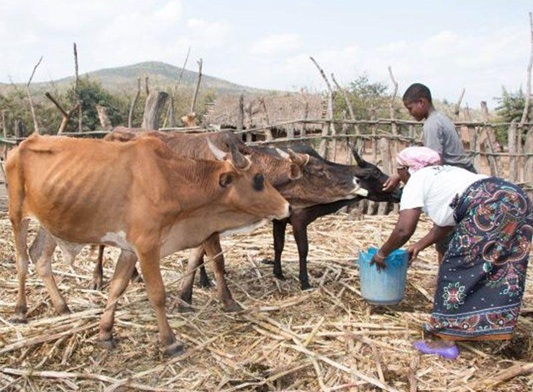
Cooperative members feeding cows
By Alick Ponje and Mark Ndipita
On the cool western slopes of Zomba Mountain, a quiet significant change is taking shape in Mpama village, Traditional Authority Malemia. What was once a loosely managed cattle-keeping activity is rapidly evolving into a structured agribusiness venture that is restoring hope, creating jobs and changing livelihoods for farming families.
For members of the Zomba Stall Feeding Cooperative, cattle are no longer simply a symbol of wealth or survival. Today, they represent enterprise, investment and a pathway out of poverty.
Just a few years ago, the cooperative’s cattle were kept in open enclosures, exposed to harsh weather, disease outbreaks and poor feeding systems that resulted in low weight gain and financial losses. Productivity remained uncertain and profits were difficult to realise.
The experience forced members to confront a painful reality: without structure, planning and proper management, livestock farming could not deliver meaningful economic returns.
Determined to change their fortunes, the cooperative embraced a modern stall-fed beef cattle fattening system under the support of the Agriculture Commercialisation (AGCOM 2) Program.
Today, the once-small village savings group is steadily becoming a commercially driven livestock enterprise with ambitions far beyond Mpama village.
The cooperative was formed in 2019 by community members who initially came together as a village savings and loans group. Over time, members identified livestock production as a promising business opportunity and shifted their focus towards beef cattle fattening.
The cooperative currently comprises 32 members, including 17 women and 15 men, reflecting growing participation of women in commercial agriculture and rural entrepreneurship.
Vice Chairperson Chimwemwe Sagona says the group’s breakthrough came after members realised they needed to move away from traditional cattle-rearing practices and adopt a business-oriented mindset.
“We were losing animals and losing weight. There was no control, no proper growth. Now everything is managed and we can actually expect to see the cattle putting on weight the way we want,” says Sagona.
Through AGCOM 2 support, the cooperative has received a grant valued at K224 million, with K104.4 million already disbursed in the first tranche. The financing is supporting construction of a modern cattle kraal, feed storage facilities, piped water systems and the procurement of beef cattle.
For the members, the investment has done more than improve infrastructure. It has transformed how they think about farming itself.
“Before this project, we were just keeping cattle. Now we are running a business,” Sagona explains. “Every animal we buy and rear has a purpose, a feeding plan and a timeline. That changes everything.”
Under the new system, every stage of production is carefully managed. The kraal is designed to accommodate 14 beef cattle at a time under strict feeding, health monitoring and weight-gain schedules until the animals reach market-ready standards.
The structured model is enabling the cooperative to operate more like a commercial enterprise than a traditional farming group. Production cycles are planned, growth targets are monitored and market arrangements are secured in advance.
Importantly, the cooperative has already signed off-take agreements with buyers, giving members confidence that their investment will generate returns.
“We already have buyers in place, so our challenge is not finding a market,” says Sagona. “Our focus now is producing enough cattle and producing high-quality beef consistently. That gives us confidence to invest properly.”
The assurance of a ready market is one of the key principles promoted by AGCOM 2, which seeks to link farmers directly to structured markets and strengthen value chain partnerships across Malawi.
For cooperative members, commercial livestock farming is already beginning to improve household welfare.
“This project is not just about cattle,” Sagona says. “When we sell, we immediately see the impact at household level. We can pay school fees, buy food and support our families. That is what motivates us every day.”
The impact of the project is extending beyond cooperative members themselves. As the enterprise expands, it is opening up employment opportunities for people within the surrounding community.
The cooperative plans to hire workers for cattle feeding, security, maintenance and other day-to-day operations linked to the enterprise.
“We will be employing local people for feeding, security and general maintenance,” Sagona explains. “It is not only members who benefit. The entire community around us becomes part of the project.”
In a rural economy where employment opportunities are limited, the enterprise is becoming an important source of local economic activity and community participation.
Situated on the hilly slopes of Zomba Mountain, the cooperative also understands the importance of environmental conservation in sustaining agricultural investments.
In line with AGCOM 2 environmental safeguards, members have integrated climate-conscious practices into the project by planting more than 560 trees around the site to protect the land from soil erosion and strong winds.
“We are on a hilly area, so protecting the environment is very important,” says Sagona. “The trees will help protect the soil, our structures and the future of this project.”
She adds: “It is also about leaving the place better than we found it. Everyone in the cooperative understands that responsibility.”
The group is also embracing sustainable farming practices through the use of cattle manure as organic fertiliser.
“The manure will be very useful in our fields,” Sagona explains. “We will also share it with other farmers in the community. It will help improve soil fertility while reducing farming costs.”
For member Abeck Bamusi, the cooperative’s progress has largely been built on discipline, commitment and a shared understanding of business principles.
When the group was formed in 2019, more than 40 people initially joined. However, not everyone remained committed to the long-term vision.
“Not everyone shared the same vision,” Bamusi recalls. “Those who stayed understood that this needed to be treated as a business and not just ordinary farming. That made the difference.”
Today, the cooperative operates with clear targets, transparent systems and shared accountability among members.
“We now plan our activities carefully and work with targets,” says Bamusi. “If you do not treat farming as a business, you fall behind very quickly.”
Even before receiving the remaining tranche of funding, members say they are already seeing the value and potential of the enterprise.
“We are building discipline and a shared understanding that this is a business,” Bamusi says. “When the livestock finally comes in fully, we want to be ready to manage every animal with purpose.”
The story unfolding in Mpama Village reflects the broader ambition of AGCOM 2 which is transforming smallholder farmers from subsistence producers into commercially oriented agribusiness players connected to reliable markets.
The Program, largely financed by the World Bank is supporting farmer organisations, SMEs and value chain actors across Malawi to strengthen agricultural productivity and commercialization.
Additional financing support comes from development partners including the European Union, Ireland, and Norway.
Back on the slopes of Zomba Mountain, cooperative members are already thinking beyond cattle fattening. Plans are underway to establish a cold storage facility within the next five years to support slaughtering and direct meat supply within Zomba and surrounding areas.
For the farmers of Mpama Village, the dream is no longer simply about owning cattle. It is about building a sustainable agribusiness capable of generating wealth, creating employment and transforming rural livelihoods for generations to come.
And as the cattle kraal steadily rises against the backdrop of Zomba Mountain, so too does a new sense of possibility for the community that dared to turn farming into business.
- 248 views