
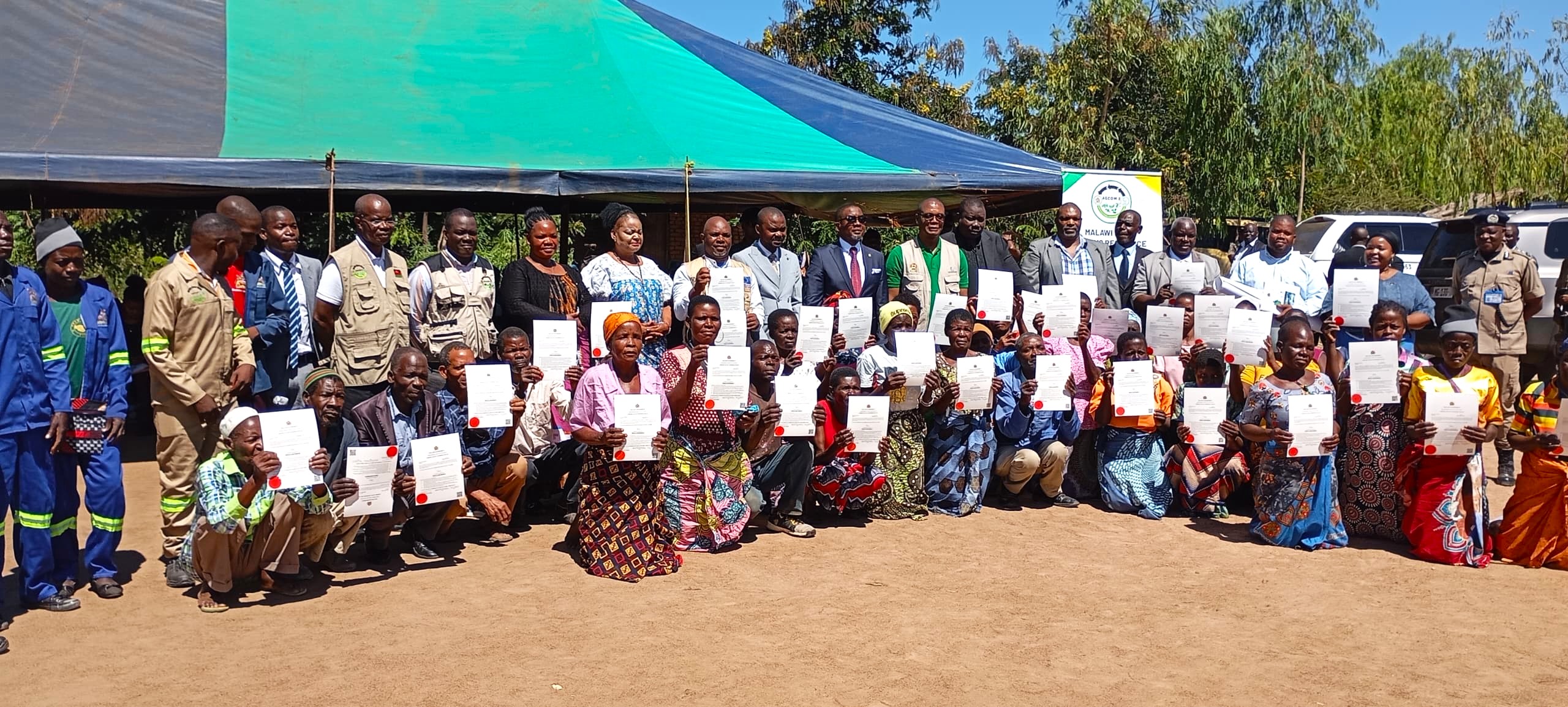
Land owners posing for a group photo with the Minister
By Enock Chingoni
Joy, relief and celebration filled the air in Traditional Authority Juma in Mulanje district as hundreds of smallholder farmers gathered to receive their Certificates of Customary Estate (CCEs), a document many described as life-changing.
For years, many families in the area cultivated land without formal documentation, leaving them vulnerable to disputes, uncertainty and fear of losing property that had sustained generations.
But on this memorable day, hope replaced uncertainty as members of Namulenga Producer Organization and farmers from Group Village Head Juma proudly walked away with certificates formally recognizing their land rights.
For the beneficiaries, the certificates are more than pieces of paper. They represent security, dignity and the confidence to invest boldly in agriculture and the future of their families.
The certificates were issued by the Ministry of Lands, Housing and Urban Development following the successful completion of a customary land adjudication, demarcation and registration exercise implemented with support from AGCOM 2.
For many smallholder farmers, land is the foundation of life itself because it is the source of food, income and family survival. Yet without formal ownership documents, many communities have long struggled with land disputes and insecurity that discouraged long-term investment.
Now, farmers in T/A Juma say they finally have peace of mind.
“I am very excited to receive this certificate,” says beneficiary Nola Tobias, holding her document tightly. “This is clear proof that the land I own legally belongs to me, and no one can take it away.”
Like many others, Tobias admits she initially feared the programme when it was first introduced.
“At first, many people thought the government wanted to take away our land,” she recalls. “But after the sensitization meetings, we understood that this programme was actually meant to protect us.”
Through extensive community awareness campaigns conducted by the Ministry of Lands, Housing and Urban Development and district authorities, misconceptions surrounding land registration were gradually addressed, encouraging more farmers to register their land parcels.
Today, the certificates are giving farmers confidence to think beyond survival farming and invest in long-term agricultural productivity.
“With secure land, we can now plan for the future,” Tobias says. “We can farm confidently, invest in our fields and even leave this land safely for our children.”
Speaking during the handover ceremony, Minister of Lands, Housing and Urban Development Honourable Chimwemwe Chipungu said the certificates issued under the Customary Land Act of 2016, as amended in 2022, formally authenticate land ownership and user rights.
“Land ownership is best secured through formal documentation that protects and legitimizes one’s rights,” said Chipungu.
He emphasized that the government’s land reform agenda is designed to empower smallholder farmers and support Malawi’s broader agricultural transformation agenda.
“Through the land reform programme, Government seeks to empower smallholder farmers with secure land tenure, promote efficient and sustainable land use, encourage meaningful investment and enhance food security,” he said.
Chipungu further urged beneficiaries to protect their certificates carefully, describing them as valuable legal documents that guarantee ownership rights.
“These certificates are official proof of your land rights and must be safeguarded against loss or damage,” he advised.
The Minister also cautioned communities against selling customary land for short-term financial gain, stressing that the law prohibits the sale of customary estates.
“The law does not allow the sale of customary estates,” Chipungu explained. “Instead, landowners are encouraged to lease land to developers under agreed terms and durations through support from district land registries.”
AGCOM 2 National Programme Coordinator Dr. Teddie Nakhumwa said secure land tenure is one of the key foundations for agricultural commercialization and rural economic transformation.
“AGCOM 2 is supporting land registration because it creates an enabling environment for agricultural commercialization by addressing one of the biggest barriers in farming which is land insecurity,” he explained.
Dr. Nakhumwa said the initiative aligns with Malawi’s long-term development vision under Malawi 2063, which prioritizes agricultural productivity, commercialization and wealth creation.
“When farmers feel secure on their land, they are more willing to invest in irrigation, soil conservation, tree planting and other productivity-enhancing activities,” he said. “That is critical for building resilient food systems and sustainable livelihoods.”
The programme is also contributing to improved governance of customary land while reducing conflicts that often disrupt agricultural production and community harmony.
Traditional Authority Juma welcomed the programme’s growing impact, particularly the increasing number of women receiving certificates in their own names.
In many rural communities, women have historically faced challenges in accessing and controlling land despite playing a central role in agricultural production.
The land registration exercise is now helping to strengthen women’s economic participation and decision-making power within households and communities.
Community leaders say the initiative is already helping reduce land-related conflicts while promoting fairness and social stability.
For many women beneficiaries, owning land legally represents both empowerment and protection.
“This certificate gives women confidence,” said one beneficiary during the ceremony. “We now know our children and families are protected.”
So far, a total of 10,485 land parcels have been successfully adjudicated and demarcated in T/A Juma alone, marking one of the major milestones in the district’s land reform process.
Beyond Mulanje district, AGCOM 2 is also supporting customary land adjudication, demarcation and registration exercises in Neno, Balaka, Dedza and Karonga districts.
The initiative forms part of broader efforts to strengthen food systems resilience, support agricultural investment and improve livelihoods for rural communities across Malawi.
As farmers proudly raised their certificates for photographs and celebration, one message stood out clearly that secure land rights are not simply about ownership. They are about opportunity.
Opportunity to invest. Opportunity to grow. Opportunity to build wealth. And above all, opportunity for smallholder farmers to participate confidently in Malawi’s journey toward agricultural commercialization and economic transformation.
- 182 views